A Shelf for Things You Actually Reach For
Arrange an accessible shelf around everyday objects, with a simple routine for keeping useful items within reach and meaningful pieces in view.
To arrange a shelf for things you actually reach for, start with the objects you used yesterday, not the ornaments you hope to display. A useful shelf should make an ordinary routine easier while leaving enough open space for the room to feel calm.
Give the shelf a week to show you what belongs there. Instead of styling everything in one sitting, notice what you reach for, where your hand naturally goes and which objects keep drifting elsewhere. Then make a small arrangement that accommodates daily use without turning the shelf into a storage ledge.
What should earn a place on the shelf?
Begin by naming the shelf’s job in plain language: perhaps it holds the keys and sunglasses you take before leaving, the mug and tea you use at breakfast, or the notebook and reading glasses you pick up in the evening. One shelf can serve more than one routine, but each item should have a clear reason to be there.
For several days, notice which objects you reach for often and which ones you return to the shelf after using. You do not need to keep a formal tally. A note on your phone, or a scrap of paper nearby, can help if your routine varies from day to day.
Separate regular-use pieces from occasional ones. A favourite candle may add warmth, but if it is rarely lit, it should not take the most convenient spot away from something you use each morning. Likewise, a decorative bowl can be useful if it catches keys; it becomes clutter when it simply collects unrelated odds and ends.
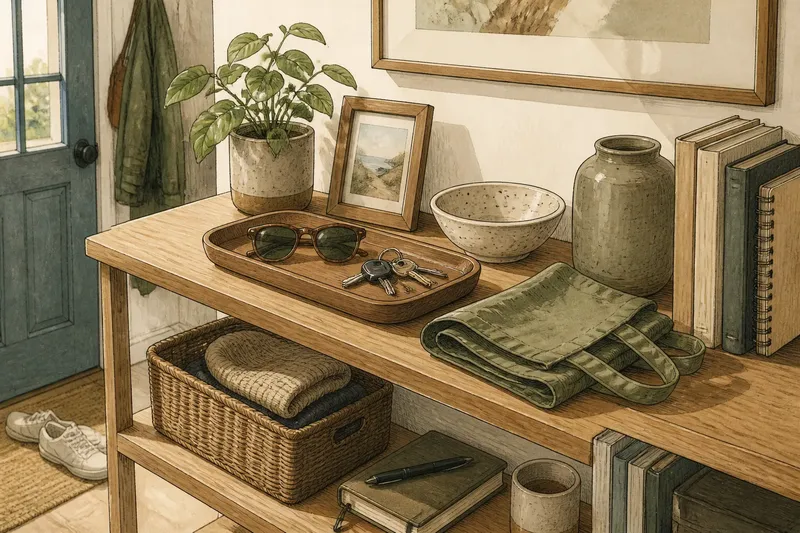
Say you notice that you leave home with your keys, sunglasses and a reusable shopping bag. You could give the keys and sunglasses a shared tray on the shelf, then place the folded bag beside it. The expected observable result is that these items have a recognisable home when you return and are easy to pick up before you leave.
How can a week reveal the right arrangement?
Use the week as an observation period, not a deadline for a perfect display. Keep the shelf in its current state at first, and pay attention to what you retrieve, what you put back and what gets displaced. A shelf that looks composed in the morning but becomes difficult to use by evening needs a different arrangement.
On the first day, what should you notice?
Look at the shelf before moving anything. Notice the items already there, the clear areas and the places your hand reaches without hesitation. If several objects are piled together, note which ones are genuinely used rather than clearing the shelf by instinct.
During the middle of the week, what should you change?
Move frequently used items towards the easiest-to-reach area, and group objects that belong to the same routine. Keep a little space around each group so you can lift one thing without shifting several others. Leave the rest in place until you have seen whether the new position suits your movements.
At the end of the week, what should stay?
Keep items you used repeatedly and any occasional object that clearly supports the shelf’s purpose. Move away things you did not reach for, especially if they make the everyday group harder to see or return. A spare spot is a useful part of the arrangement, not a gap that must be filled.
What if several people share the shelf?
Give each person a recognisable place, using a small tray or a simple left-to-right arrangement rather than relying on memory. If an item has no dependable owner or return place, decide together whether it belongs on another surface. The shelf works best when everyone can put things back without rearranging someone else’s belongings.
Where should the everyday objects go?
Put the most frequently used pieces in the easiest position to reach from where you approach the shelf. Objects used together should sit near one another: a notebook beside a pen, or a small tray beside the door-side edge for keys. Keep this grouping practical rather than rigid; the arrangement should follow the way you move through the room.
Consider both reach and visibility. A shallow tray can stop small items wandering, while an open basket may be better for a soft item such as gloves. Choose containers that let you see what is inside if you need to find something quickly. Deep boxes can hide useful belongings and encourage unrelated items to collect together.
Keep objects you handle often on an open surface, not behind a stack of decorative pieces. If you need both hands to move ornaments before reaching the everyday item, the display is working against the shelf’s purpose. Less frequently used objects can sit to the side or on a higher or lower shelf, provided they remain safe and accessible for the people who use them.
Leave enough room to return items without careful placement. When every object has to be aligned precisely, a busy household is unlikely to maintain the arrangement. A little breathing space around the tray, book or bowl gives your hand room to set things down naturally.
How do you make useful things look considered?
Visual breathing room comes from deciding what not to display as much as from choosing what to show. Keep the working group small and let a few objects carry the shelf’s character. A framed photograph, a ceramic dish or a small plant can sit beside useful belongings, but each should have space of its own rather than competing with them.
Look at the shelf from the place where you normally see it. If a tall object blocks a smaller one, shift the taller piece to the side or use a lower object nearby. Varying height can add interest, but avoid building a tower that makes everyday items awkward to reach.
Repeated materials can bring a mixed collection together without making it match exactly. A wooden tray, a woven basket and a paper notebook may feel at home together if their colours sit comfortably with the room. The point is not to buy accessories to complete a look; use containers you already own if they suit the task.
Meaningful objects deserve space, too. Choose one or two with a personal connection rather than giving every keepsake a place on the everyday shelf. A small display can make the room feel like yours, while a crowded assortment may make both the useful and sentimental pieces hard to notice.
What should you do when the shelf stops working?
When things pile up, look for the point where the routine breaks down. If keys are left beside the tray, perhaps the tray is too small or too far from the place you enter. If a notebook is always moved to make room, it may belong elsewhere. Change the location or container that causes the friction instead of repeatedly tidying the same symptoms.
When a new object arrives, decide whether it serves the shelf’s purpose before adding it. If it replaces an older item, remove the older one. If it belongs to a different routine, find another home for it. This simple pause helps keep the shelf from becoming the default landing place for everything without a clear destination.
If the shelf is shared, agree on what should remain accessible and what can move. A short conversation can prevent one person’s useful arrangement from becoming another person’s obstacle. Keep the decision specific: name the items, their places and what should happen when the shelf is full.
How can the arrangement stay useful over time?
Use a brief reset when you notice that the shelf has become hard to use. Return items to their places, remove anything that belongs elsewhere and restore the open area around the everyday group. This is not a full reorganisation; it is a way to recover the arrangement you already know works.
Reconsider the shelf when your routine changes, such as moving from a daily notebook to a different way of keeping notes, or needing a new place for entryway essentials. Let the objects you reach for lead the adjustment. Keep the meaningful pieces that still matter, but do not let an old arrangement dictate where current necessities must go.
A well-used shelf does not need to stay immaculate. It needs to make the next ordinary action easier: finding the keys, picking up the glasses or returning the book. If the things you reach for are visible, accessible and easy to put back, the shelf is doing its job—and a little open space leaves room for life to change.