The Clear Route Through a Room
A clear route through a room makes its layout easier to read. Learn to spot everyday movement paths and adjust furniture without disrupting the room.
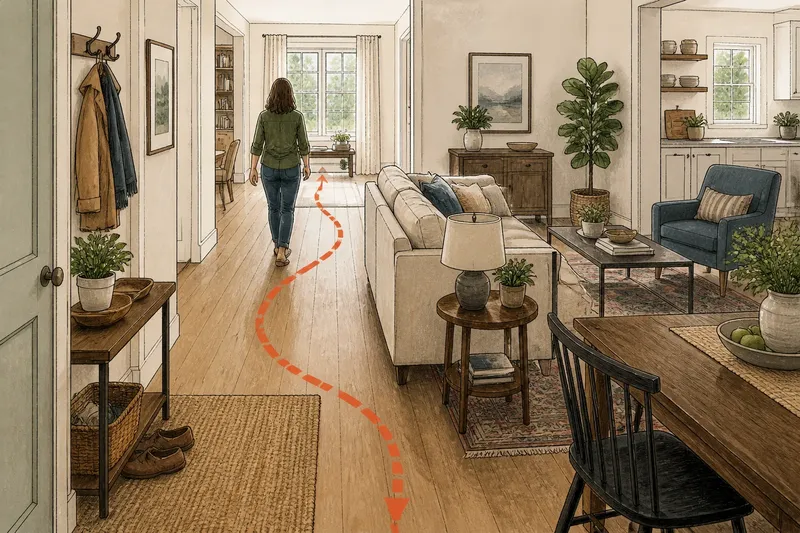
A clear route through a room is often the difference between an arrangement that feels settled and one that makes people hesitate. Before shifting a sofa or buying a smaller table, watch how you and your household already move through the space: the line from the doorway to a seat, from the kitchen to the dining table, or around a chair to reach a window. Those repeated journeys reveal the room’s working routes, which furniture can support rather than obstruct.
Why does the room feel awkward to cross?
When a room is hard to cross, the cause is not always a narrow doorway. A route may bend around a chair, cut between a coffee table and the sofa, or pass through the middle of a group of seats. Each detour interrupts movement and can make the arrangement appear less coherent, even if every piece looks attractive on its own.
Start by naming the trip that feels awkward. Is it the walk from the hall to the window, the path to a dining chair, or the journey between the sofa and the kitchen? A specific route is easier to assess than a general feeling that the room is cramped. Observe it at ordinary times, including when people are seated and when a door is open.
Common causes include furniture placed directly in a doorway’s line, a side table projecting into a passage, or a chair that must be pulled out across the main route. Rugs can also disguise the problem: a rug edge may suggest a route that furniture then cuts across. Look at the entire journey rather than just the tightest point.
Try moving the smallest obstruction first. Turn a side table so its corners sit clear of the walking line, or shift a chair closer to the seating group if that leaves a more direct approach. Then walk the route again. If the obstruction is a large piece, test a temporary change before committing to a full rearrangement.
How can you spot the routes people already use?
Watch ordinary movement without directing it. Notice which door people use, where they pause to take off shoes, how they approach a seat, and whether they pass behind or in front of someone who is sitting. The route people choose may differ from the one the furniture arrangement seems to invite.
Look for small clues as well as obvious traffic. A chair repeatedly left at an angle may be turned to make room for passage. A rug that creeps out of alignment may be crossed at its corner. A floor lamp repeatedly nudged aside may be occupying a useful route. These signs do not prove that a particular arrangement is wrong, but they help identify where to pay attention.
Try observing at different moments: when the room is empty, during a normal evening, and when several people use it. A path that works for one person may become awkward when another person is sitting at the table or opening a cupboard. If household routines differ, note the routes that matter most rather than trying to make every possible crossing equally direct.
For a simple record, sketch the room on paper and mark doors, fixed cupboards, windows and the main furniture. Draw arrows for the routes you see, using a separate line for each regular journey. Where arrows overlap a chair or table, note whether people actually squeeze past it, move the object, or choose another way. This sketch is a record of use, not a scale drawing or a furniture plan.
Why does a supposedly open path still feel blocked?
A route can look clear from the doorway and still feel uncomfortable once someone walks it. A table corner may protrude at hip height; a chair back may make a passage feel pinched; or the route may force a sharp turn immediately after entering. Check the path at walking pace and from the direction people approach it. A plan viewed from above cannot show every obstruction in use.
Also notice what happens at the route’s edges. A coat draped over a chair, a basket beside a console, or an open drawer can narrow a passage that seemed adequate when the room was tidy. If an item regularly lives there, treat it as part of the layout rather than an occasional exception. The arrangement needs to work with ordinary belongings in place.
Try moving a small object out of the line first, then repeat the same journey. If the route remains awkward, consider whether the furniture is aligned badly or whether the passage is serving too many purposes. A dining chair may need room to pull out, while the same patch of floor is also being used as the route to another part of the home. In that case, shifting a nearby piece can help, but the room may need a different seating or dining arrangement.
What should you move first when routes cross?
Begin with the piece that creates the clearest conflict, not the largest piece in the room. A floor basket or occasional table may be enough to open a direct line. If a larger item is responsible, decide what must remain accessible: doors must open, drawers must be usable, and people should be able to approach seats without stepping through someone else’s space.
Change one thing at a time and walk the same route after each adjustment. This makes it easier to see which move helped and which only shifted the obstruction elsewhere. If a heavy item is involved, avoid lifting it alone; follow the furniture maker’s handling guidance or ask for help.
Say you notice that the route from the hall to a window passes between a coffee table and the end of a sofa, where a person has to turn sideways. Imagine moving the table nearer the seating group while keeping the route outside the sofa’s end. The expected observable result is a more direct walk to the window and enough room to approach the seats; if the table then blocks access to the sofa, the adjustment has simply transferred the conflict.
Before moving several pieces, use masking tape to mark the proposed table or chair position on the floor. Walk through the route and sit down as usual. Tape is useful for checking how the new arrangement feels without dragging furniture around, but it cannot reproduce a chair being pulled out or a door being opened, so include those actions in your trial.
How can you tell whether the route is clear enough?
A route does not need to run in a perfectly straight line. The practical test is whether people can complete the usual journey without an unnecessary squeeze, a sharp detour, or repeated contact with furniture. A gentle curve around the seating area may suit the room better than a straight line that cuts through it.
Check the route with the room in its normal working state. Open doors and cupboards that people use, pull out the dining chair, and leave everyday items where they usually belong. Notice whether someone can pass while another person sits down or stands up. If the route only works when the room is empty, the arrangement may not suit its ordinary use.
Ask household members which journeys they avoid or find irritating. Keep the question specific: “Can you get from the doorway to that seat without moving anything?” is more useful than “Does the room feel right?” Different answers can reveal that one person’s direct route crosses another person’s preferred place to sit.
Which route problems do people commonly ask about?
Should the main route run through the centre of the room?
Not necessarily. A central path can split a seating group and make it feel like a corridor, while a route along the edge may leave the room’s main activity undisturbed. Follow the journeys people actually make, then choose the line that keeps both movement and use of the room comfortable.
What if the doorway points straight at a chair?
Check whether people need to walk past the chair or approach it from the doorway. Turning the chair or shifting it towards the other seats may keep the route open without removing it from the group. Try the adjustment with someone seated, since an occupied chair takes up more usable space than an empty one appears to.
Can a rug make a route harder to read?
Yes, if its edge seems to lead into furniture or if people keep crossing a corner that slips out of place. Repositioning the rug or adjusting nearby furniture may make the path easier to read. Follow the rug maker’s care and placement advice, especially where a rug could move underfoot.
What if several routes compete for the same space?
Decide which journeys happen most often and which need access at the same time. Keep those movements in mind as you test the arrangement, while allowing less frequent routes to take a gentle detour if that suits the room. Do not solve one crossing by making a seat, cupboard or doorway difficult to use.
How do you keep the route clear after rearranging?
Once a change seems promising, use the room normally for a while and notice whether objects drift back into the passage. A small tray may have become a drop-off point; a chair may be pulled out and left across the route; or a basket may be placed where it is easiest to reach. If the same blockage returns, the object may need a different home or the furniture may still be inviting the wrong path.
Keep the useful route visible rather than marking it permanently. Let furniture edges, an open approach to a doorway, or a clear strip beside the seating group show where movement belongs. Recheck the arrangement when the room’s use changes, such as when a temporary work surface or extra chair is introduced. A clear route through a room is not empty floor for its own sake: it is a deliberate line that lets people reach what they use without breaking the way the rest of the room hangs together.