The Overhead Light Is Not the Whole Plan
A layered lighting plan gives each room useful task light and a calmer evening mood, without asking one ceiling fixture to do every job.
A layered lighting plan starts with a familiar frustration: the ceiling light is on, yet the room still feels harsh at the table and gloomy by the sofa. One overhead fixture can provide general light, but it cannot comfortably serve every activity and mood from a single position. Think of lighting as a choice between three approaches: rely on the ceiling fitting, add local task lights, or combine both with softer ambient sources.
What can an overhead light do well?
A ceiling fixture spreads light across much of a room, making it useful when you first enter, tidy up, or need to see the whole space. A shaded pendant can also give a dining table a clear visual centre. In a small room, a well-positioned fitting may provide enough general light for many ordinary tasks.
Its limitation is direction. Light from above can leave faces shadowed, create glare on a screen, or cast your own shadow over a book or work surface. Dimming helps adjust brightness, but it does not change where the light lands. A single fitting is best treated as the room’s broad layer, not a substitute for light beside the things you use.
Would task lighting suit your routine?
Task lighting puts light close to a particular activity. A reading lamp beside an armchair, a desk lamp aimed at paperwork, or a counter light over food preparation can make those areas easier to use without brightening the entire room. This approach suits people whose activities happen in distinct spots, or who prefer not to switch on a strong ceiling fitting for a short task.
Choose the lamp for the job and the position. A shaded table lamp can keep a bulb out of direct view; an adjustable desk lamp can aim light at the page rather than the eyes. For reading, place the source to the side of your usual seat and check that your hand does not cast a distracting shadow. A floor lamp is useful where a table is impractical, though its base and shade still need space.
Local lighting is less helpful when it leaves routes and surrounding areas very dark. If a task lamp creates a bright island against a black-looking room, add a gentle background source rather than asking the task lamp to illuminate everything.
When does ambient lighting make a difference?
Ambient light softens the contrast between a bright task area and the rest of the room. It might come from a table lamp with a fabric shade, a wall light that reflects off a pale surface, or a floor lamp aimed upwards. The aim is not to remove every shadow; it is to make the room feel comfortably legible when the main fitting is off.
This option suits rooms used for conversation, winding down, or several activities that do not need concentrated light. It also gives you more control over the room’s character: a ceiling fitting can stay available for practical use while lower lamps create a quieter evening setting. A pale wall can help reflected light spread, while dark or textured finishes may absorb more of it, so judge the effect in the actual room.
Ambient sources can be decorative as well as useful, but a sculptural lamp is not automatically a good light source. Check whether its shade directs light where you want it and whether the bulb is visible from your seat. The fitting’s label and manufacturer instructions determine compatible bulbs and dimming; follow them.
Which lighting approach fits your room?
Use the room’s routine to decide how much layering it needs. A compact utility space used briefly may work with a ceiling fitting and one well-placed task light. A living room that shifts from reading to conversation often benefits from all three layers. A dining area may need a focused pendant for meals, with a nearby lamp or wall light for a softer setting afterwards.
- Choose ceiling-first if you mainly need broad, simple illumination and rarely use the room for detailed tasks.
- Choose task-first if one or two activities dominate and their locations are clear.
- Choose layered lighting if the room changes use or you want both practical brightness and a relaxed evening mood.
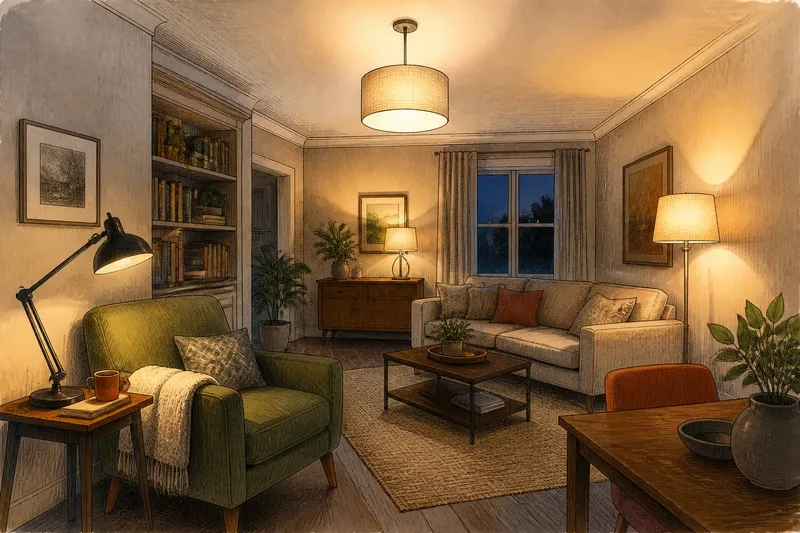
Say you use a living room for reading beside the sofa and chatting with visitors. Keep the ceiling fitting for tidying, add a shaded lamp beside the reading seat, and place a softer lamp near the opposite wall. The expected result is a room where reading has a useful pool of light, conversation does not happen under a glaring bulb, and the ceiling fitting remains available when you need to see the whole space.
What should you consider before adding a lamp?
Start by noticing where light is missing rather than buying a fitting because a corner looks empty. Sit in the usual places at the time you use the room. Look for glare, shadows on a page, and areas that disappear when the overhead light is off. Then choose a source that addresses one of those observations.
Check the lamp’s footprint, switch access, cable route, shade opening, and the direction its light will travel. A tall floor lamp can be awkward behind a frequently moved chair; a small table lamp may be easier to position but too low to light the room beyond its immediate surface. If there is no convenient socket, choose a suitable placement before settling on a lamp, rather than letting a trailing cable dictate the layout.
Which lighting questions come up most often?
Can I use lamps without turning on the ceiling light?
Yes, if the lamps provide enough light for the activity and the route through the room remains easy to see. Combine a local task lamp with a softer source elsewhere when one pool of light feels too stark.
Should all the bulbs have the same colour?
Keeping nearby sources similar can make the room feel more coherent, while a noticeably cooler task light may feel separate from a warm living area. Compare the bulbs in their actual fittings and choose a balance that suits the room’s finishes and use.
Is a dimmer enough to replace extra lamps?
A dimmer changes the level of a compatible ceiling light, but it cannot move the light closer to a book or lift it towards a wall. Use a dimmer for flexibility, and add another source if you need light in a different place.
How many light sources does a room need?
There is no fixed count: a room with one clear activity may need fewer sources than a space used for reading, dining, and relaxing. Add only what solves a visible problem, then consider whether the controls are convenient to use.
A useful layered lighting plan is not a collection of lamps for its own sake. Keep the overhead fitting for broad visibility, then add light at the places where the room asks you to read, work, or settle in. If each source has a distinct job, you can leave some switched off and still make the room feel considered.